

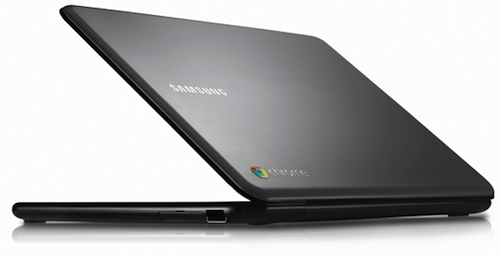
Chromebooks are basically netbooks optimized to run the Chrome OS, which is a special Google customized version of Gentoo Linux optimized to run a special version of the Chrome web browser. What differentiates Chromebooks from other notebooks is a special Google keyboard that features browser specific keys and a search button (in place of a caps lock key), an oversized Macbook-like trackpad, high battery

The first two Chromebooks that will be available are made by Samsung and Acer. Both of them feature a dual core Intel Atom processor, built in Wi-Fi and optional 3G, 4-in-1 memory card slot, two USB slots, an HD webcam, and HD audio support.
There isn’t a lot that’s different about them. The Samsung Chromebook has a mini-VGA port for external screen connectivity, a 12.1-inch screen, and 8.5h estimated battery life while the Acer Chromebook has an HDMI port, a 11.6-inch screen and 6h of battery life.
The price is between $429 and $499 for a Samsung Chromebook, and $349 for an Acer one, and they will be initially sold at Best Buy and Amazon.com in the U.S. Google is also offering Chromebooks to schools and businesses for a three-year subscription instead of an upfront payment for the device. The subscription will include the device itself, warranty, and tech support. Schools will be charged $20 a month while businesses and government agencies will have to pay $28 a month for a subscription.
At the end of these three years Google will offer to replace the Chromebooks, presumably if the subscription continues, at no extra charge. Some have dubbed this “hardware as a service” in addition to “software as a service” that is a common term for web applications running in the cloud.
The intent behind the Chromebooks is to provide a quick and seamless way to connect to the web and use web applications. They are effectively disposable web appliances, as their sole purpose is to facilitate the usage of web applications. Google wants to take advantage of the fact that most of our activities are already web-centered, and that there is a growing number of cloud-hosted web applications that can replace their “offline” desktop counterparts.
Chromebooks are designed to, then, cut the clutter that is a full blown desktop operating system, with all the complexity that it comes with, and allow the users to go straight to the web and do all of their computing “in the cloud”. This results in a few interesting features such as the ability of all the apps as well as the Chrome OS itself to remain constantly up to date without any user intervention, and the ability to have the exact same user experience on multiple Chromebooks since all of the settings, installed apps and all data are stored in the cloud, independent of the physical machine used to access them.
This is, however, met with mixed reactions. Some rightly believe that Chromebooks come with too little and too late, promoting netbooks at a time when their popularity is rapidly waning in the face of tablets, a market in which Google itself plays a major role with its Android operating system. Tablets can already be considered as good web appliances, and arguably offer a little more, such as a novel and more natural input method, and additional Android and iOS apps.
On the other hand, Chromebooks could potentially find some niches to thrive in. They could be useful for people who are turned off of tablets (perhaps due to dislike for touch screen typing), and don’t need anything more than what existing web applications can offer, or would use Chromebooks as a complementary device to a full blown laptop or a PC.
In any case, it would seem that Google is putting its eggs in multiple baskets. Chromebooks seem to be an alternative to tablets, but Google has its hands in both markets. Whichever market wins out, Google is bound to profit from it.
For a full feature guide visit the Google’s Chromebook site.


